Erich
Narcissus and GoldmundErich is the blacksmith’s nearly twenty-year-old son who becomes Goldmund’s friend, helper, and apprentice at Mariabronn. His practical skill and eager attention help Goldmund establish a workshop and create an ambitious body of carvings; when Goldmund returns from his last journey gravely ill, Erich is the one who remains at his bedside. Through him, the novel shows artistic creation not as solitary inspiration alone, but as work made possible by tools, materials, teaching, and loyal company.
Background and First Connection
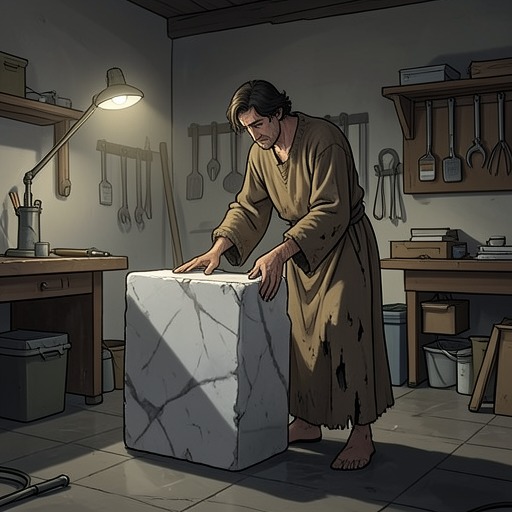
Erich enters the story as a dreamy young man working with his father, the blacksmith. After Goldmund returns to Mariabronn, he sets about building the material conditions for sculpture: he orders tools, chooses timber, and works at the forge to make the knives, chisels, drills, and planes his carving requires. Erich is drawn to Goldmund and helps him with these preparations, becoming his friend in the process. His connection to the workshop begins in labor and shared curiosity rather than in a formal appointment.
The friendship also answers a need in Goldmund’s changed life. At times Goldmund feels useless and depressed in the cloister and in the presence of Narcissus; with Erich, whose admiration is warm but shy, he recovers some of his animation. Erich asks about Master Niklaus and the bishop’s city, and Goldmund sometimes tells him about his earlier travels. These conversations make Goldmund newly conscious of the distance between his past adventures and the work he is now beginning: he can sound like an old man recounting former life, even as he senses that his life as an artist is only starting.
Assistant, Friend, and Apprentice
Erich’s enthusiasm makes him more than a source of practical help. Goldmund promises to teach him the lute, lets him try carving, and gradually treats him as a pupil. During the creation of the refectory carvings, Erich is the only person besides Goldmund allowed to see the work as it develops. Goldmund sometimes gives him small tasks and demonstrates aspects of the craft; at other times, he closes the workshop even to Erich. This alternation preserves the solitude of artistic labor while allowing a trusted apprentice to participate in it.
From the second year of the two-year project, Erich is formally given to Goldmund as an apprentice. The arrangement grows from their existing friendship and from Erich’s eagerness to learn; Goldmund even considers asking Erich’s father to release him so that he might train as a permanent assistant. Erich’s apprenticeship thus represents a possible continuation of Goldmund’s craft beyond the single work at hand. His desire to become an artist is not merely abstract: he observes the labor closely and is permitted to test his own ability at carving.
The Workshop and the Work
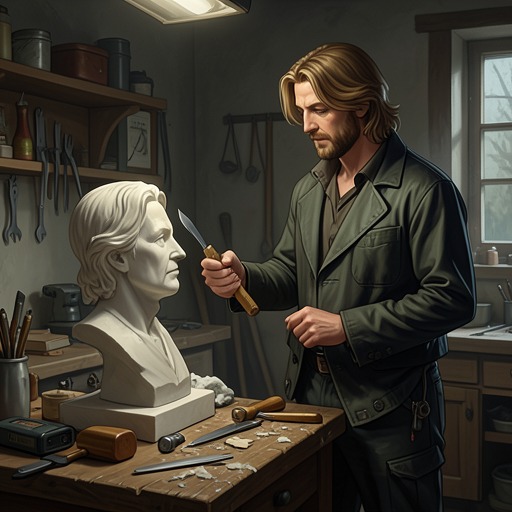
The workshop becomes a setting where Goldmund’s art can take physical form and where Erich can see the range of his teacher’s creative life. Goldmund builds the tools and gathers the timber himself, while Erich helps with the work and joins him at the forge. Later, the carving group grows around a spiral staircase: its imagery includes creatures, plants, animals, and people, with Noah among grape leaves and grapes. The balustrade becomes a densely worked paradise of trees, brush, herbs, birds, and animals, alongside scenes from the patriarchs’ lives.
Erich sees this creation unfold over two years, including the periods when Goldmund works with sustained concentration and the occasional breaks when restlessness sends him into the countryside. Goldmund returns from those excursions and resumes carving with renewed energy. Erich’s presence provides both an audience and a learner: Goldmund can show him parts of the process, while Erich’s faith in the work encourages him. The workshop thereby joins solitary creation to transmission, as the master’s carved world becomes, for the apprentice, a possible model for a future vocation.
Goldmund’s Return and Erich’s Care
When Goldmund returns after his final journey, Erich recognizes him but is shocked by how much he has changed. Goldmund appears much older, tired, and unwell; he offers no account of where he has been and asks only to sleep. He also tells Erich not to announce his return yet, postponing any explanation or public homecoming. Erich’s response is immediate concern rather than demand for stories: he respects Goldmund’s request and sees him at a moment when the familiar artist seems almost unrecognizable.
The illness proves grave. After Goldmund’s condition is examined, he is carried to a sick room, where Erich keeps constant watch. Goldmund’s last journey remains incompletely known: he offers a few details, while others are inferred, and Narcissus records fragments of his reports and confessions. Erich is one of the people who can supply what he witnessed. His role at the end therefore extends beyond apprenticeship. He becomes a caretaker and a surviving witness to Goldmund’s final return, preserving a limited but important part of the account of the artist’s last days.